All it really takes is once.
One time to screw up in business to lose a customer. But really, the first time interaction is the most critical.
Toastmasters International has a Club Success Series training presentation that talks about Moments of Truth for Toastmasters Clubs. Basically, the presentation highlights the opportunity for the club to shine and keep a member or fall on their face and lose that member.
The most crucial moment is the first time a guest visits a club. If they aren’t properly welcomed, if no one explains what is happening during the meeting, and/or if the meeting is run poorly, then there is a good chance that visitor will not be back and thus, not become a member.
There are other moments where you could lose a new member, but the most crucial is the first meeting…this is their first impression. If it’s bad here, one might assume that it’s all downhill from here.
I think in business we have the same type of Moments of Truth. The first time customer is always the most vulnerable to never come back. If they have been a customer for a while and you make some mistakes along the way, they are generally more forgiving–they have time vested in the relationship and don’t really want to throw it away.
So, what are the Moments of Truth for your company. What are the few things that you can focus on doing perfect all the time because these are the things that a new customer will see and, if done poorly, could turn them away.
You heard the three things a new visitor might notice. Not being welcomed, not understanding what is going on, and the meeting is run poorly. Let’s examine their three and see how they fix that and you consider what are your big rocks that you can work on.
The emphasis is that these are the things that every club must do well all the time and they have proven methods to make this happen in every club.
The Greeting. Every club is encouraged to have a person that is dedicated to greeting every single person as they arrive at the meeting. Toastmasters has this “thing” about shaking hands and it’s a rule that every member should shake every person’s hand when they arrive. Think about the impact that would have on a new visitor that every single person at the meeting made a point of coming up, shaking their hand, and welcoming them to the meeting. So, pretty simple–always have a greeter (it’s the Sergeant At Arms job) and everyone greets everyone at every meeting. Moment one solved.
Understanding. Now that you know someone is new to the meeting, because everyone greeted that person, you have the opportunity to sit that person next to someone who can explain what is going on during the meeting. Between knocking on the table when the word of the day is used to the general flow and purpose of meeting activities, a Toastmasters meeting can be rather confusing. Once you understand why the meeting runs the way it does, a visitor will feel more comfortable. Moment two solved.
The Meeting. Part of Toastmasters effectiveness is teaching people how to run effective meetings. Thus, every single meeting has an evaluator. This means that every meeting should be run well. They start and end on time, the agenda is set and followed, and the meeting runs smoothly. By following the standard club approach, fully training Toastmasters of the Day, and having good evaluations, every meeting should run well and everyone attending should enjoy them. Moment number three solved.
As you were reading these moments, can you think of similar situations where you have a new customer and that one thing or those few things could turn me off and they simply never come back. These are the things you need to do well every time.
Of course, there are other times in a new member’s experience that could sour them to a club…like their first speech, the first time they run a meeting, etc., but now that they are a member, they generally are more accepting.
So, in your business, you have that opportunity to make a first impression…one that is positive…if you focus on the few things that are your Moments of Truth and do them exceptionally well.

 Strategic planning, as a structured and systematic process, is successful when it is leader-led and overcomes the five reasons 70% of all strategies fail. Learn how to see your plan through to success. The strategic planning process is where leaders of an organization establish the vision of the organization’s future and then develop and implement the actions necessary to achieve that future. This article expands on the strategic planning concepts addressed in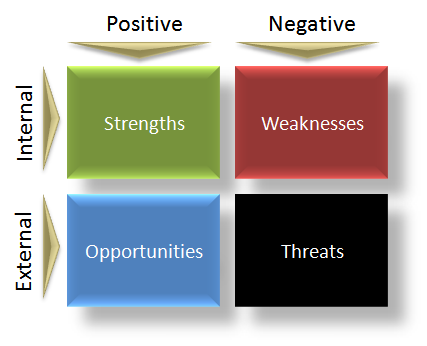
 Strength. Strengths are internally positive aspects about the organization. These are the things that make the organization strong and are the main things an organization can leverage to overcome internal weaknesses and external threats. Organizations tend to focus only on their weaknesses and take their strengths for granted. A failure to focus on and nurture your organizational strengths can quickly turn them into a negative. When you brainstorm to build a SWOT, you tend to come up with a lot of perceived strengths, some of which might not be true.
 Weakness. Weaknesses are also internal to the organization, but these are the challenges that could prevent the organization from achieving its eventual vision. Only the most glaring weaknesses are normally highlighted by an organization when brainstorming and usually this list is short. When done correctly, this tends to be a long and difficult list for leaders to swallow. Although it doesn’t sound like SWOT, I often refer to this box as Challenges (a SCOT). Nothing in an organization will prevent it from achieving its vision, unless they fail to address the challenges in front of them.
 Opportunity. Many times Opportunities and Threats can be the same thing, but simply it’s the way you look at them. Basically, these both fall into a risk category. Opportunities are positive and external to the organization. If you have an opportunity that exists within your organization, then it is a Strength that you just aren’t leveraging at the moment. The importance of focusing on the external factor of it is that there is less of a guarantee that you can turn Opportunities into Strengths. Many organizations, especially those that don’t currently have a strategic plan or the one that exists is poor, fail to focus on the external factors. Extremely effective strategies focus more on the external factors then the internal. This is how you develop strategic positioning and become prepared for the what might happen versus dealing with it when it happens.
 Threat. Obviously, Threats are the external negative aspects surrounding an organization. These are significant threats that the organization faces or could face in the future that they have no control over. Competitors and government regulations often fall into this category. If your organization is part of a bigger organization, things like down-sizing, reorganizations, and funding, even though they exist in the greater organization, still can be external to your control. The two biggest things about Threats is to determine ways to either turn a Threat into an Opportunity, or to develop a mitigation plan should the Threat materialize.